The Loudness Trap: More Volume Is Not More Detail
Learn how to compare music at different listening levels, hear quiet details more fairly, and choose a volume that serves the sound rather than masking it.
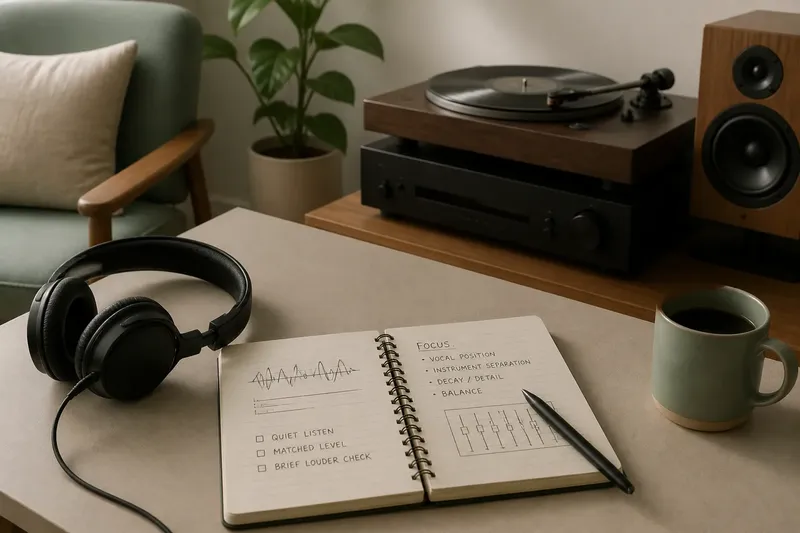
You turn up a song to catch the soft shaker behind the vocal, and suddenly the whole mix feels more vivid. The bass seems weightier; the guitar’s pick attack jumps forward. That lift can make louder listening feel like better listening, but volume changes more than the size of the sound. To compare recordings fairly, separate what becomes easier to hear from what merely becomes more forceful.
What loudness changes
At a higher playback level, quiet elements may become easier to notice because they stand out more clearly against room noise and the rest of the music. A faint harmony, cymbal decay, or breath between sung phrases can become perceptible. But louder playback also makes the entire mix more prominent, including its strongest parts. The kick drum may hit harder while the small detail you were seeking remains just as buried.
Our hearing does not treat every frequency as equally prominent at every level. As playback gets louder, bass and treble can seem more prominent relative to the middle of the spectrum. That can change the apparent balance of a mix: a dark recording may seem brighter, and a restrained bass line may seem more substantial. The change is a listening impression, not proof that the recording contains extra detail.
Think of the mix as a shelf of objects under a lamp. Turning the lamp up makes the whole shelf brighter; it does not move a small object closer. Louder playback can bring a soft sound above the room’s noise floor, but it can also make a forceful sound dominate your attention. Those are different effects, and careful comparison keeps them apart.
Three listening approaches
Quiet, focused listening
Start at a comfortable, modest level in a reasonably quiet room. This approach suits listeners who want to follow balance and arrangement without the physical impact of loud playback. Listen for the vocal’s position, the separation between instruments, and whether a soft part is audible at all.
Quiet listening is especially useful for asking whether a detail survives as part of the mix rather than appearing only when the whole song is forceful. It can also reveal whether your attention has been drawn to a sound by its musical role or by its sheer level. Its limitation is simple: room noise, headphones, or speakers may mask quiet elements.
Matched-level comparison
For comparing two versions or two playback settings, bring them to roughly the same perceived loudness before judging their detail. This suits anyone choosing between mixes, comparing a stream with a local file, or checking whether a change in playback level altered an impression. A small difference in overall loudness can tilt a quick judgment toward the louder option.
Use a short passage with both quiet and strong moments, such as a verse that opens into a chorus. Switch between versions without changing other settings, and adjust the playback level so neither one simply wins by sounding louder. Then listen for a specific feature: the consonants in the vocal, the tail of a piano note, or the placement of a backing part.
Brief louder checks
A brief increase can help when you need to distinguish a quiet sound from background noise or hear how a dense section feels at a more immersive level. This suits listeners who already know what they are checking for. Keep the comparison short, return to the earlier level, and ask whether the detail was genuinely present or whether the louder passage simply commanded more attention.
Do not make extended loud playback the default. Strong sound can become tiring, and fatigue makes subtle judgments less dependable. If you feel a need to keep raising the volume, pause or return to a comfortable level rather than treating the urge as evidence that the mix lacks detail.
Choosing a fair comparison
Begin with one question, not a general hunt for “more.” Are you trying to hear a backing vocal, judge the balance between bass and drums, or compare how two versions handle a quiet passage? A defined target helps prevent loudness from becoming the answer to every listening question.
- Hold the passage steady. Compare the same section, not a quiet verse in one version with a loud chorus in another.
- Keep the playback chain consistent. Use the same headphones or speakers and avoid changing equalizer settings between listens.
- Match perceived level first. If one version sounds clearly louder, lower it before deciding that it has more presence or detail.
- Name the sound you seek. Listen for a particular instrument, vocal layer, or decay rather than asking whether the whole mix sounds clearer.
- Check the room. A fan, street noise, or nearby conversation can mask quiet sounds; reduce distractions before turning up.
- Return to a comfortable level. Confirm that the impression remains when the music is no longer more forceful.
Say you are comparing two mixes of the same imagined song, and the second seems to reveal a soft tambourine. You notice that it is also louder overall. You lower that version until its general level feels comparable, then replay the same verse. If the tambourine still stands out, you have a stronger reason to think the mixes differ in balance; if it recedes, loudness may have shaped the first impression.
Which method fits?
Choose quiet, focused listening when the goal is to understand arrangement, balance, or the character of an intimate passage. Choose matched-level comparison when judging versions, playback sources, or changes to a mix. Use a brief louder check only when you have a specific sound to locate or want to assess the impact of a fuller level.
These approaches answer different questions. A quiet listen asks what is perceptible without added force. A matched-level comparison asks whether two presentations differ when loudness is not doing the persuading. A brief louder check asks how a passage behaves when it becomes more prominent. Moving among them is more useful than treating one setting as the universal truth about a recording.
Questions about loudness?
Does louder playback reveal hidden instruments?
It can make a quiet part easier to hear if that part was close to the room’s noise floor. It cannot create an instrument that is absent or reliably separate a part that is masked by other sounds.
Why does the louder version sound clearer?
Greater level can make bass and treble feel more prominent and can draw attention to the entire mix. That shift may produce an impression of clarity even when the details themselves have not changed.
How should I compare two recordings?
Use the same passage, playback equipment, and listening position, then bring the versions to a similar perceived loudness. Focus on one feature at a time so a louder overall presentation does not settle the comparison for you.
What if I still cannot hear the detail?
Try a quieter room, a different passage where the sound has more space, or playback equipment that suits your listening needs. If the detail remains elusive, the mix may simply place it low or blend it into other sounds.
Detail without strain
The loudness trap is not that turning music up never helps. It is that a louder presentation can feel more informative before you have checked what changed. For a fair comparison, match levels, keep the passage and playback chain steady, and listen for a named feature. If you want to compare music at different listening levels, make loudness one condition you control rather than a shortcut to detail.
A useful final check is to stop adjusting the volume and let the passage play again at a comfortable level. Notice which details remain easy to follow and which depend on extra force. That distinction tells you more about the recording and your listening conditions than the volume knob alone.