From Parlour Song to Recorded Standard
From parlour song to recorded standard: hear how home performance gave way to repeatable recordings, and listen for what each format makes shared.
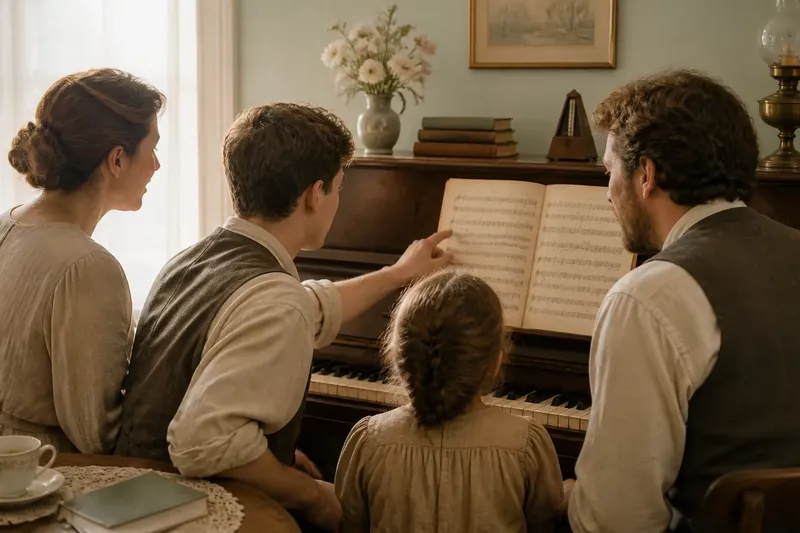
A family gathers around an upright piano, and someone sets a sheet of music on the stand. One person picks out the melody; the others join when they know the words. The history of the popular song, from parlour song to recorded standard, begins with this kind of shared, imperfect performance—not with a single definitive sound.
To hear the change clearly, spend a week following one song across its possible lives: as a tune learned at home, a piece circulated in print, and a recorded performance that listeners can replay. The point is not to rank one format above another. It is to notice how the meaning of “everyone knows this song” changes when music travels from room to room through objects and machines.
The room makes the song
In domestic music-making, a song had to work for the people present. A piano could carry the harmony, while voices supplied the tune and words. Skill varied, and so did the tempo, key, phrasing, and number of verses. A singer might linger over a line or skip a verse; the group’s version belonged to that gathering.
Printed sheet music helped a tune travel beyond its first room. It offered melody, lyrics, and accompaniment in a form that households could try to reproduce. But notation did not erase local choices. A player still had to interpret the page, and the people singing could reshape the tune around their range and confidence.
Think of a song as a recipe copied onto paper: the written directions make it portable, but each kitchen still brings its own hands and habits. In the parlour, shared familiarity came from doing the song together, not from matching a master performance.
Follow one song this week
Choose a familiar song with a melody you can recognize, ideally one available as sheet music and in more than one recording. Keep a notebook or a note on your phone. Each day, focus on a different way the song is carried and shared.
- Day one: Recall. Without playing anything, write down the tune or a few lyric lines you remember. Notice which parts arrive clearly and which you fill in by instinct.
- Day two: Read. Look at a published score or a legitimate sheet-music edition. Trace the melody and lyrics, and mark places where the page leaves room for interpretation, such as tempo markings or expressive phrasing.
- Day three: Imagine the room. Read the words aloud, then hum the melody at a comfortable pitch. Consider what a small group would need to make the song work together: a clear starting note, a manageable range, or a steady accompaniment.
- Day four: Hear a recorded version. Listen once without following the score. Note the lead voice, instrumental support, and any sections that seem especially shaped for a solo performer.
- Day five: Compare another version. Choose a recording with a noticeably different arrangement or vocal style. Listen for what changes and what remains recognizable enough to identify the same song.
- Day six: Return to the page. Compare one recorded phrase with the notation. Notice what the performer adds through timing, tone, articulation, or changes in emphasis.
- Day seven: Sing it your way. Hum or sing a section from memory, alone or with another person. Notice which details you retained from the page and recordings, and which choices feel natural to your own voice.
If you cannot find a score, use the lyric sheet or another reliable written version and focus on the words and section order. The week still works: the question is how the song’s carrier shapes what you hear, not whether every historical version is available.
The recording fixes a moment
A recording changes the listener’s relationship to variation. A particular singer’s phrasing, the instrumental arrangement, and the balance between voice and accompaniment can be replayed. That repeatability gives listeners a shared reference point: people can recognize the same recorded details even if they have never sung the song themselves.
Yet a recording is not the song in its entirety. It is one performance captured and presented for listening. The performer may stretch a phrase, alter the melody slightly, or make a word feel tender, sly, or emphatic. The microphone and arrangement also shape attention: a close voice can feel intimate, while a prominent piano part can make harmony more noticeable.
Compare the recording with your own humming. If your version keeps the tune but changes its pace or emotional weight, you have not necessarily misremembered it. You are hearing the difference between a repeatable rendition and a song that remains available for adaptation.
What makes a standard?
A “standard” is not simply a song that has one famous recording. It is a song that remains recognizable across performances and arrangements. Its melody, words, or harmonic shape give later singers and players something stable enough to work with, while leaving room for decisions that make a new rendition distinct.
That stability can be modest. A listener may recognize a song from its opening phrase, even when the instrumentation changes. Another listener may rely on the lyrics or the way the chords lead into the refrain. Familiarity accumulates through different routes, so two people can share a song without sharing the same first version of it.
Questions listeners ask?
How is a parlour song different from a recorded standard?
A parlour song is associated with domestic performance, often supported by piano and voices in the same room. A recorded standard is a song whose identity travels through repeatable performances, even as singers and arrangements change.
Did sheet music make every household perform songs alike?
No. Notation could circulate a melody and accompaniment, but players still made choices about tempo, emphasis, and vocal fit. The people in each room also shaped how confidently and fully the song was performed.
Why can different recordings sound like the same song?
They may preserve recognizable features such as the melody, lyric, or harmonic movement. Arrangement, vocal tone, and phrasing can shift while those identifying features remain audible.
Can a song be shared if listeners only hear recordings?
Yes. Listeners can share recognition, memories, and reactions to a recording without performing the song together. Their connection differs from the coordination of singing in a room, but it is still a form of shared listening.
Listen for the carrier
During your week, keep one question beside the song: what is carrying it right now? It may be a printed melody, a singer’s breath, a piano’s chords, or a recording’s repeated phrasing. Naming the carrier helps distinguish the song’s durable identity from the details each performance contributes.
That distinction makes the journey from parlour song to recorded standard easier to hear. A song can begin as a practical invitation to join in, become portable through notation, and reach distant listeners through a fixed performance. When you hear a familiar recording again, try humming its melody without copying its phrasing. The small gap between the two reveals how much of a shared song lives in the tune—and how much arrives with the person who sings it.